


Researchers Sound the Alarm on AI’s Impact on Student Learning
by Stephen Leeb, PHD and Megan Davis
AI is flooding into every aspect of life in the U.S. today—including our classrooms. And that, according to one of the most authoritative measuring sticks of educational achievement, is damaging our children.
Results from the latest round of PISA (Program for International Assessment) tests were released this week, and they were chilling. The tests, which are organized by the OECD (Organization for Economic Cooperation and Development), score 15-year-olds around the world on their skills in reading, math, and science. A record 91 countries and economies participated in the most recent testing. Around the globe, average test scores were the lowest ever recorded—while students in the U.S. produced their lowest scores in math and reading in more than two decades.
Stephen Leeb, PhD > Turbulent Times Investor News is a reader-supported publication. To receive new posts and support my work, consider becoming a free or paid subscriber.
Across OECD countries, reading scores fell by an average of 25 points. In the U.S., reading scores plummeted by 14 points to reach a near-25-year low for the country. Some have attributed at least part of this decline to the pandemic. But it seems more plausible that any effects from the pandemic would have been reflected in results from the 2018-2022 period. Overall, the top six countries in reading were Asian. The U.S. was ranked 13th. In math, the U.S. came in 27th, while the top seven positions were held by Asian countries.
Tracey Burns, chief of global strategy and research at the National Center on Education and the Economy (NCEE) told the Washington Post: “China is back. [They are] heads and shoulders above the rest of the group, particularly the U.S.”
In addition to taking the tests, students also filled out a questionnaire that included questions about their use of AI. The chart, available on PISA’s website showing the 2025 results, shows that the greater the use of AI, the lower the test scores. In fact, the difference in scores between students that used AI and students that didn’t amounted to approximately an entire year of learning.
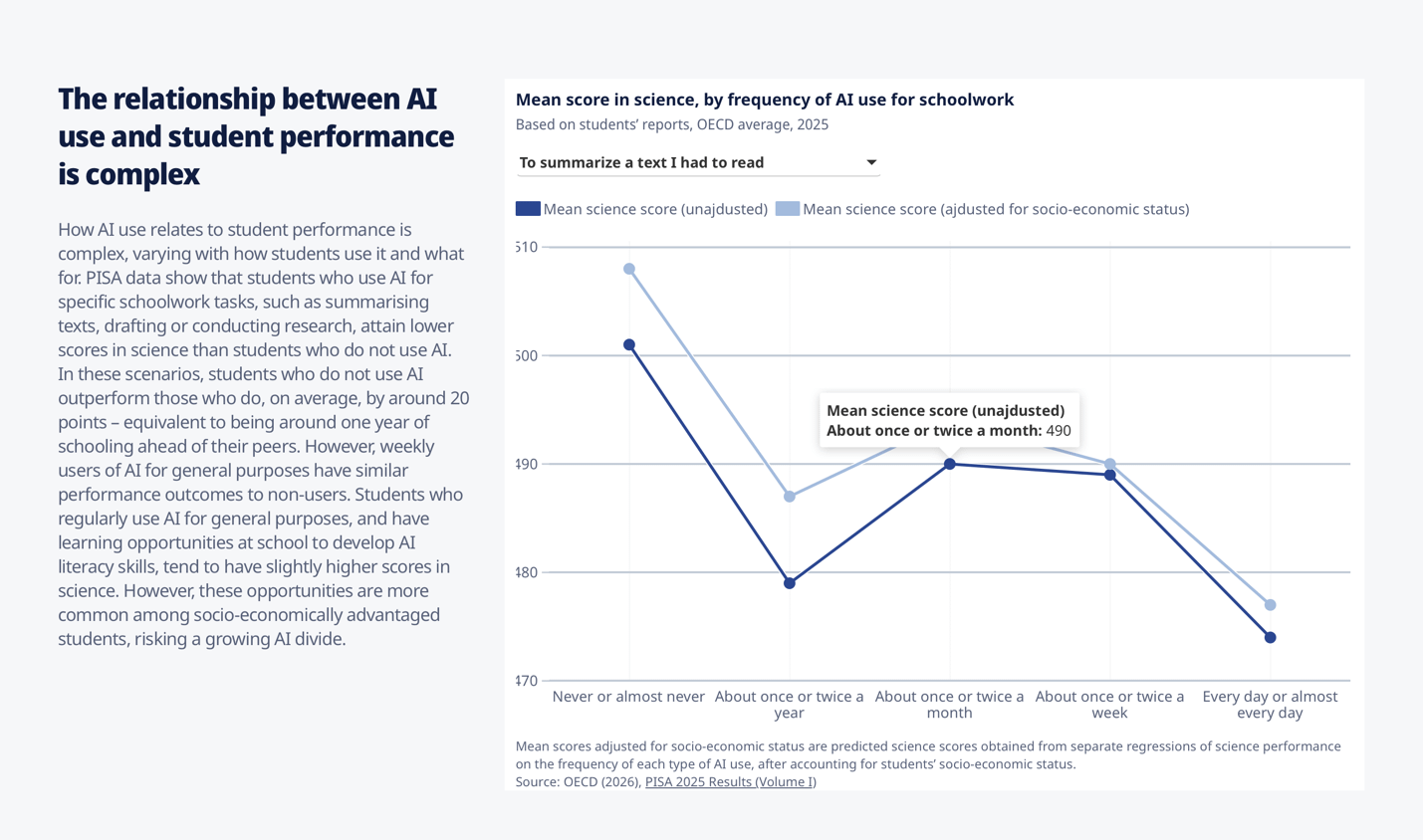
On average, students who didn’t use AI for their schoolwork averaged about 20 points higher than students who did. In science, there was a 30-point difference between students who never or rarely used AI and those who used it every day. To put those 30 points in perspective, a 30-point difference in science scores would take the U.S. from 13th place to 6thplace. A 30-point difference in math would take us from 27th to 11th. In reading, it would take us from 13th to 3rd.
The questionnaire also showed that more than half of the students were vulnerable to misinformation. Given that, depending on the data used to train it, AI can be highly prone to providing wrong or misleading information, that’s not surprising—but it doesn’t make it any less alarming. Moreover, these PISA results are based on tests conducted in 2025. Rand, a nonpartisan nonprofit global research organization, published a paper this March that showed that in May 2025, around 48% of U.S. students in middle school and up were using AI. By December 2025, the percentage had risen to 62%. In other words, since the PISA tests were administered, more schoolchildren here are using AI than at the time of the tests—suggesting that test scores are only going to keep declining unless AI usage is curtailed.
If we’re going to help our children thrive, it’s urgent that we address the negative role of AI in learning. In New York City, Mayor Zohran Mamdani recently instituted a moratorium on the use of generative AI for all students in the city’s public schools through 8th grade, including preschool. That means that in the nation’s largest school district, students in those grades will not be allowed to use any programs that generate text, images, or audio from prompts. Chatbots that provide mental or emotional support have also been banned, and limits have been imposed on the amount of time students can spend on screens.
This is the first major push we have seen in the U.S. to tackle what is clearly a serious problem. We hope to see others follow suit. Education in the U.S. has been getting worse for years, and it needs to become a priority. The PISA results clearly show that AI won’t be coming to the rescue. Far from being our savior, it is one of the most destructive things in classrooms today. Our children deserve a brighter future. If we continue to allow AI to take over the classroom, we not only face an accelerating decline in our education system, but we also risk forfeiting the creativity and individuality of our children. That would make our country’s future look very bleak indeed.

Here are the benefits you unlock with a paid subscription:
- Full access to Turbulent Times Investor Newsletter (monthly edition)
- 60+ stock recommendations featured in our Core Investment Portfolios
- Individual articles on recommended stocks
- Buy/Sell/Hold Recommendations
- Portfolio Recommendations
- In My Opinion – where you can ask questions about anything
Our Substack blog, videos, and YouTube channel deliver compelling discussions on current events, geopolitics, macroeconomics, and educational content for investors. By raising awareness and empowering investors with knowledge, we enable them to make confident, well-informed investment decisions. Stephen Leeb, Ph.D., shares valuable wisdom and practical insights to help investors grasp market dynamics and geopolitical influences that present both risks and opportunities. Navigating the complex investment landscape can be overwhelming for the average retail investor, but our rigorous research on critical financial topics aims to equip investors with the tools to analyze independently and succeed in today’s market.
Follow the links below to visit Stephen Leeb’s official YouTube channel:
https://www.youtube.com/@StephenLeebPhD_TTI
Visit Stephen’s Interview “Archives” on YouTube!